
The Education Advisory Board (EAB) brings together leading voices from higher education, research and global policy to examine the future of education at a system level. Launched in September 2025 by Education in Motion (EiM), the board convened at its inaugural summit at Dulwich College (Singapore) on 27 April.
As part of this work, a series of student-led thought leadership interviews has been developed across Dulwich College International and Dehong schools. These conversations are designed to connect students directly with global experts, creating space for rigorous dialogue and meaningful intellectual exchange.
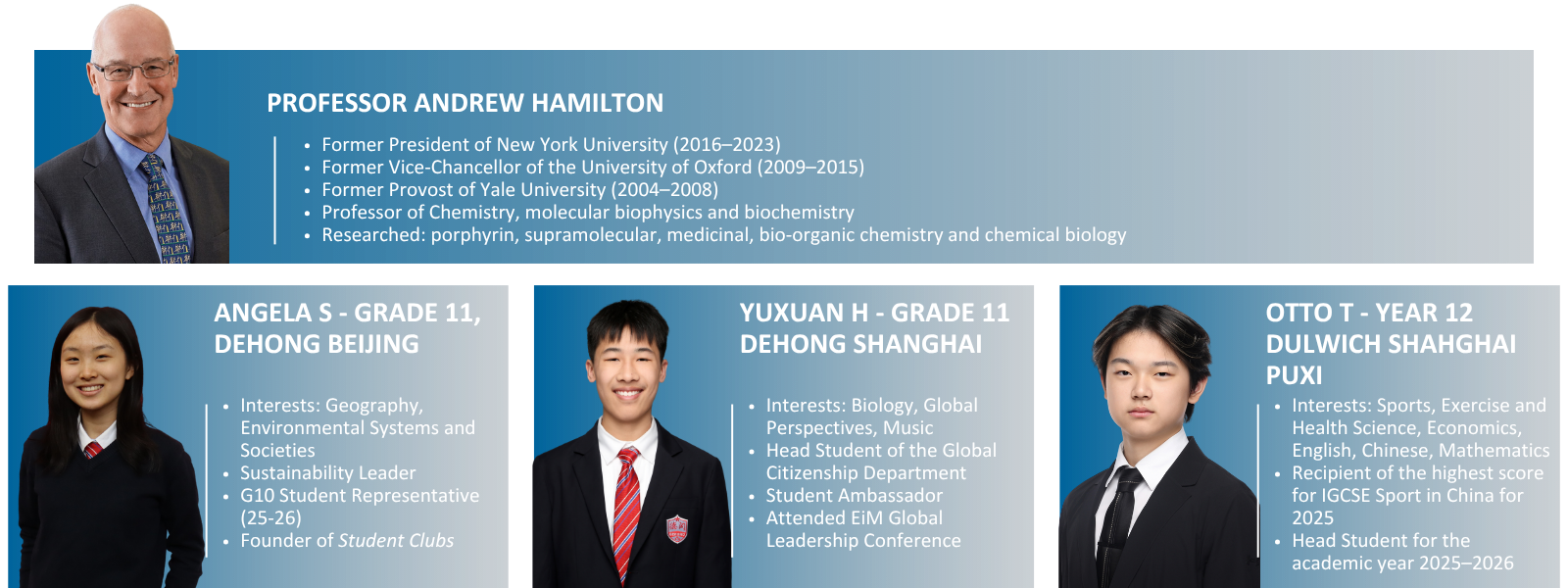
This next episode in the series features Professor Andrew Hamilton, a chemist who went on to lead both the University of Oxford and New York University. In this conversation, students Otto T from Dulwich College Shanghai Puxi, Angela S from Dehong Beijing International Chinese School and Yuxuan H from Dehong Shanghai International Chinese School examine how passion develops, how leadership is practised and how to remain adaptable in a changing world.
Falling in Love and Embracing Opportunities
Students draw out Professor Hamilton’s story of finding chemistry, from unexpected beginnings to a lifelong fascination with discovery.
Yuxuan H: You were a chemist before moving into leadership. What inspired you to become a chemist in the first place?
I actually often ask myself that. When I was young, I was not particularly interested in chemistry. I did not do any experiments in my parents’ basement or have a chemistry set. It was through doing my A-levels that I realised I was good at chemistry. That is how I decided to study it at college, without really having a great passion for it.
During my undergraduate at the University of Exeter in the UK, I began to enjoy the problem-solving character of chemistry. To understand biology, the nature of cells and human disease, you really need chemistry. That was how I truly fell in love with chemistry and realised it was the subject I wanted to dedicate my life to.
In a similar fashion I fell in love with research. When you are a student at school or in college, it's all rather passive, you are not advancing the subject. When you get involved in research, you realise not only how much still is not known and is not understood, but that you can play a role in helping advance the subject and understanding issues.
Some may already know what they want to do at 17 years old, but for me it came later. Keep your mind open—there’s still much to explore during school. When you find a subject that really excites you and gets your heart beating a little faster, leave that opportunity open.
Angela S: Was there a specific project or moment from your laboratory career that stands out to you as the most personally or professionally meaningful?
When I was a student at university, I actually fell in love with two entities. One was a young woman, who became my wife of the last 45 years. The other entity was a very beautiful molecule, called a porphyrin ring. It is the molecular ring at the heart of haemoglobin—the protein that carries oxygen in your blood.
I can go on for days about it, but I first encountered it in Vancouver, then studied it for my PhD at Cambridge, and later during a postdoctoral period in Strasbourg, France, with my mentor Jean-Marie Lehn, who went on to win the Nobel Prize.
I fell in love with the molecule’s beautiful structure—its fourfold symmetry, the way an iron atom sits in the centre of the ring and its crucial role in biology. Falling in love with this molecule drove my lifelong dedication to chemistry. And, of course, it's nice to fall in love with someone who then becomes your wife.
The Art of Having Other People See Your Way
A shift from science to leadership is not always shaped by a clear plan, but by unexpected and often remarkable opportunities.
Otto T: What inspired you to shift from hands-on laboratory research to university administration?
I’m going to answer very candidly: nothing ‘inspired’ me. I never intended to become a university administrator. I was a full-time scientist and I was very happy and content, teaching, doing research and working with my students at Yale. I had no intention of becoming university president or leader.
But life will throw some interesting moments at you and you have no idea what they are going to be. I was at Yale doing my duty as head of the chemistry department when suddenly I got an email from the provost, which is the second-in-command of the entire university, and they asked me to become provost for science for the whole university.
That was Susan Hockfield. She told me: ‘Andy, I know you don’t want an administrative job, but I would really appreciate it if you would help me for just a few years.’
So I said yes, and then she surprised me. After just one year, she left and, being the remarkable woman she is, became the first woman president at MIT. After that, I got a phone call from the president of Yale, who was Rick Levin at the time. We now work together on the EAB for EiM. He asked me to take Susan’s position as provost of the entire university. And I could not say no to him. We ended up working together for four years and then I went on to Oxford and so on.
So, I didn't have any particular inspiration or desire to become a university leader, but I had people who inspired me during my academic leadership life. It is important to keep your options open. Don’t automatically say no. I ended up quite enjoying the challenge of being in leadership.
Otto: How has your scientific mindset shaped your approach to institutional leadership throughout your career?
I think it had a huge effect. I realised fairly quickly that the issues I faced as provost or vice-chancellor were very similar to those I faced running a research group. To run my lab I had to manage more than 30 people, manage a budget, raise money, buy equipment and chemicals and so on.
Perhaps the most important of all, I had to persuade students to dedicate the next maybe five years of their lives to work on a project in my lab. University leadership is the same.
University leadership is the art of letting other people have your way. It's letting them—almost without realising it—buy into your vision and have them engaged so deeply with that vision that it becomes their own.
University leadership isn’t like the army—you don’t shout orders and expect people to salute and carry them out. You have to inspire people and help them truly buy into the vision you’re laying out. Just as importantly, you have to listen. Being a university president doesn’t mean you know everything; others will have insights that help refine the vision and the goals.
Angela: You mention the importance of listening to others. What leadership skills have you found the most valuable at each stage of your career?
Listening remains the most important leadership skill—don’t be shy about it. I had no inkling I would become a provost or president, but I learned on the job, especially from mentors and others in similar roles. Always keep learning from others—their successes, and perhaps even more importantly, their mistakes—and apply both their experience and your own to the challenges you face.
And be ready to change. When evidence or circumstances change, be flexible and humble enough to change your mind. Don’t be too dogmatic or intransigent—adapt as the world changes.
Always Adapting While Staying True to What Matters
Even as technology and circumstances change, staying true to what matters remains the constant that guides progress.
Yuxuan: You were President of NYU during the peak of the COVID-19 pandemic. Was the shift to online learning a setback for the university experience, or did it show that higher education is more agile and should adopt new ways of teaching?
I spent nearly seven years at the University of Oxford, an institution over 900 years old. When you are part of a university like that, you are constantly reminded that universities have always dealt with change—wars, the bubonic plague, the printing press, the internet and now AI. This isn’t new.
Did the educational experience suffer during COVID? It certainly changed—‘suffered’ is probably the wrong word. There was no choice; it was about the safety of our community. I often compare it to a snowstorm in New York—we didn’t stop, we went online. COVID was a rather prolonged snowstorm.
It wasn’t better or worse, it was just different. But it made us appreciate what we had—being together, in person, learning from one another.
At the same time, we embraced online learning, and it has become an integral part of teaching. My own subject uses the ‘flipped classroom’—you watch the lecture online, and use classroom time for discussion and problem-solving.
So yes, it changed things. But universities have always adapted—and they will continue to do so.
Angela: As a last question, with the rise of AI in recent years, what is one piece of advice you would like to leave students with?
I’m not sure any of us know the impact AI is going to have—I include all of us in that. It will be big, but none of us truly know. So we have to keep our minds open.
I sometimes sound very old saying this, but when I went to university, we didn’t have laptops—we didn’t even have electronic calculators. I arrived in 1971 with a slide rule in my pocket. Computers existed, but they were the size of a double-decker bus. And yet, despite all this staggering technological change, in a funny way, nothing changes—we are still human.
I teach a course now on the chemistry of art. We begin with cave paintings 20,000 years ago—charcoal and ochre on walls—and take it all the way to modern, fluorescent pigments. Picasso, after seeing those cave paintings, said: ‘Nothing has changed.’ Those artists and us—we live, we love, we express ourselves in much the same way.
So yes, AI is another technological advance—and there will be another one after that. The world doesn’t stop. My advice is to stay true to the things that matter. Make sure you truly understand your subject. Just because you can ask ChatGPT something doesn’t mean you understand it.
Don’t offload the hard thinking. You can offload the mundane, but grapple with complexity—whether it’s a poem, a chemical reaction, or a piece of art. That foundation is what allows you to understand the world and to use technology for what it is: a tool, nothing more.
Looking Ahead
The Education Advisory Board convened its inaugural summit at Dulwich College (Singapore) in 27 April 2026, which brought together leading voices from higher education, research and global policy for focused, high-level dialogue on the future of education.
While the Board operates at a system level, this series offers a complementary perspective—creating structured opportunities for students to engage directly with these ideas in conversation. Through these exchanges, students demonstrate not only curiosity, but a clear ability to grasp, question and extend complex thinking. In their dialogue with Professor Hamilton, they respond with insight, reflection and thoughtful challenge.
The series continues on to examine the ideas shaping education and the responsibilities that come with them.